
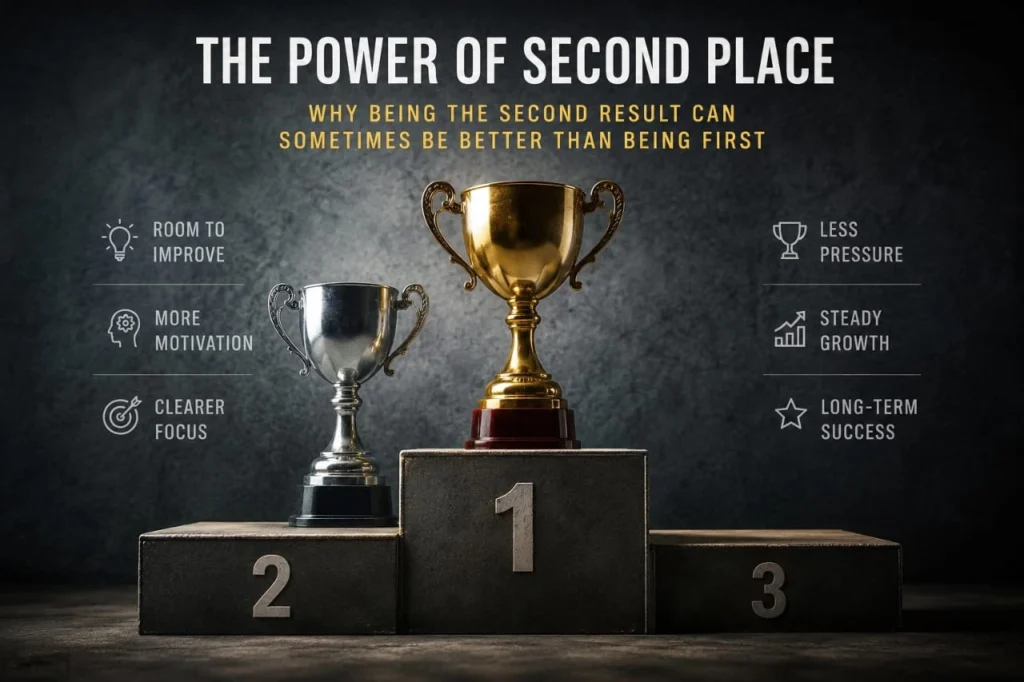
The Power of Second Place: Why Being the Second Result Can Sometimes Be Better Than Being First
For years, businesses and content creators have treated the first position in Google search ranking as the ultimate measure of Success in Second Place. Ranking number one on Google search results appears to offer an obvious advantage: more visibility, more clicks, and potentially more organic traffic. Consequently, companies invest significant time and resources in SEO strategies designed to reach the top position. However, this approach assumes that the first result always delivers the greatest value. In reality, search behavior is more complicated. Users do not simply click the first result automatically. Instead, they scan several listings, compare titles, examine descriptions, and consider which result best matches their needs. Therefore, the second result can sometimes attract highly qualified visitors, generate stronger engagement, and even produce better business outcomes than the first. Search visibility matters, but visibility alone does not determine success. 1.First Does Not Always Mean Most Relevant In Google search ranking Search engines attempt to match results with user intent rather than simply displaying information randomly. Although the first result often represents a strong match, it may not perfectly address what the searcher actually wants. Meanwhile, the second result might present a clearer explanation, a more specific solution, or a more compelling title Success in Second Place. For example, someone searching for “best project management software for small businesses” may see a broad software comparison in the first position. The second result, however, might focus specifically on affordable solutions for small teams. If that second page addresses the searcher’s exact situation, the user may choose it instead. Thus, relevance can outweigh ranking position. 2.The Psychology Behind the Success in Second Place Users rarely interact with Google search ranking mechanically. Instead, they evaluate information within seconds. They look at headlines, descriptions, recognizable brands, publication dates, and perceived credibility. As a result, the second listing has an opportunity to compete directly with the first rather than simply accepting a lower position that’s the Success in Second Place. Moreover, some users deliberately avoid clicking the first result. They may assume that the top listing represents an advertisement, a highly competitive website, or a page that does not provide an independent perspective. Consequently, the second result can benefit from appearing slightly more neutral or informative. This behavior demonstrates an important principle: search rankings influence attention, but they do not completely control decisions. 3.Click-Through Rate Tells a Different Story In Google search ranking SEO rankings provide useful information, but marketers should not evaluate performance through position alone. The click-through rate in Google search ranking, commonly known as CTR, provides a more meaningful picture of how effectively a search result attracts users that is Success in Second Place. A page ranking second with an excellent title and compelling meta description can outperform a first-place page with weak messaging. For instance, imagine that the first result receives a 5 percent click-through rate while the second receives an 8 percent rate in Google search ranking. Even though the second page occupies a lower position, it attracts a larger percentage of searchers who see it. Therefore, marketers should optimize titles and descriptions instead of obsessing exclusively over ranking position. Furthermore, a strong CTR can indicate that a page aligns well with user expectations. When visitors consistently choose a second-place result, that behavior signals that the content communicates its value effectively. Ranking position remains important, but engagement provides additional evidence of search performance. 4.The Advantage of Standing Out Success in Second Place The first search result often receives considerable attention in Google search ranking, but it also faces intense competition from other top-ranking pages. When several results occupy similar positions, users may compare them carefully. A Success in Second Place can stand out by offering something different. For example, a first result might use a generic title such as “Complete Guide to Digital Marketing.” A second result could use a more specific headline such as “The Practical A Digital Marketing Guide for Small Businesses. The second title clearly conveys who it’s intended for and what it aims to achieve.. Therefore, even though it ranks lower, it can create a stronger connection with the right reader in Google search ranking. Additionally, businesses can use unique value propositions to differentiate their pages. They can highlight original research, practical examples, updated statistics, expert insights, or actionable recommendations. Consequently, the second position can become an opportunity to compete through relevance and clarity rather than relying solely on ranking authority. 5.User Intent Can Beat Position In Google search ranking Success in Second Place means Understanding user intent remains one of the most important elements of modern SEO. Searchers usually have a specific objective when they type a query. They may want to learn something, compare products, find a service, solve a problem, or complete a transaction. A page that understands this objective can outperform a page with a higher ranking. Consider a person searching for “how to improve website speed.” The first result might provide a technical explanation intended for experienced developers. The second result could offer a simple step-by-step guide designed for beginners. If the searcher has limited technical knowledge, the second page provides greater value. Therefore, businesses should create content around the audience’s actual needs rather than attempting to satisfy search engines alone. Search engine optimization works best when it supports a strong user experience. By identifying user intent and addressing it directly, a second-place page can attract visitors who are more likely to remain on the website and take meaningful action. 6.Better Content Creates Better Outcomes (Success in Second Place) Ranking first cannot compensate for poor content. If a page loads slowly, provides outdated information, lacks structure, or fails to answer the user’s question, visitors may leave quickly. In contrast, a second-ranking page that delivers comprehensive and useful information can retain users and encourage further interaction. Content quality also affects what happens after the initial click Success in Second Place. A visitor who finds useful information may read additional articles, subscribe to a newsletter, request a quote, purchase a product, or