

Success in Second Place
Uncategorized

The Power of Second Place: Why Being the Second Result Can Sometimes Be Better Than Being First

For years, businesses and content creators have treated the first position in Google search ranking as the ultimate measure of Success in Second Place. Ranking number one on Google search results appears to offer an obvious advantage: more visibility, more clicks, and potentially more organic traffic. Consequently, companies invest significant time and resources in SEO strategies designed to reach the top position. However, this approach assumes that the first result always delivers the greatest value. In reality, search behavior is more complicated. Users do not simply click the first result automatically. Instead, they scan several listings, compare titles, examine descriptions, and consider which result best matches their needs. Therefore, the second result can sometimes attract highly qualified visitors, generate stronger engagement, and even produce better business outcomes than the first. Search visibility matters, but visibility alone does not determine success. 1.First Does Not Always Mean Most Relevant In Google search ranking Search engines attempt to match results with user intent rather than simply displaying information randomly. Although the first result often represents a strong match, it may not perfectly address what the searcher actually wants. Meanwhile, the second result might present a clearer explanation, a more specific solution, or a more compelling title Success in Second Place. For example, someone searching for “best project management software for small businesses” may see a broad software comparison in the first position. The second result, however, might focus specifically on affordable solutions for small teams. If that second page addresses the searcher’s exact situation, the user may choose it instead. Thus, relevance can outweigh ranking position. 2.The Psychology Behind the Success in Second Place Users rarely interact with Google search ranking mechanically. Instead, they evaluate information within seconds. They look at headlines, descriptions, recognizable brands, publication dates, and perceived credibility. As a result, the second listing has an opportunity to compete directly with the first rather than simply accepting a lower position that’s the Success in Second Place. Moreover, some users deliberately avoid clicking the first result. They may assume that the top listing represents an advertisement, a highly competitive website, or a page that does not provide an independent perspective. Consequently, the second result can benefit from appearing slightly more neutral or informative. This behavior demonstrates an important principle: search rankings influence attention, but they do not completely control decisions. 3.Click-Through Rate Tells a Different Story In Google search ranking SEO rankings provide useful information, but marketers should not evaluate performance through position alone. The click-through rate in Google search ranking, commonly known as CTR, provides a more meaningful picture of how effectively a search result attracts users that is Success in Second Place. A page ranking second with an excellent title and compelling meta description can outperform a first-place page with weak messaging. For instance, imagine that the first result receives a 5 percent click-through rate while the second receives an 8 percent rate in Google search ranking. Even though the second page occupies a lower position, it attracts a larger percentage of searchers who see it. Therefore, marketers should optimize titles and descriptions instead of obsessing exclusively over ranking position. Furthermore, a strong CTR can indicate that a page aligns well with user expectations. When visitors consistently choose a second-place result, that behavior signals that the content communicates its value effectively. Ranking position remains important, but engagement provides additional evidence of search performance. 4.The Advantage of Standing Out Success in Second Place The first search result often receives considerable attention in Google search ranking, but it also faces intense competition from other top-ranking pages. When several results occupy similar positions, users may compare them carefully. A Success in Second Place can stand out by offering something different. For example, a first result might use a generic title such as “Complete Guide to Digital Marketing.” A second result could use a more specific headline such as “The Practical A Digital Marketing Guide for Small Businesses. The second title clearly conveys who it’s intended for and what it aims to achieve.. Therefore, even though it ranks lower, it can create a stronger connection with the right reader in Google search ranking. Additionally, businesses can use unique value propositions to differentiate their pages. They can highlight original research, practical examples, updated statistics, expert insights, or actionable recommendations. Consequently, the second position can become an opportunity to compete through relevance and clarity rather than relying solely on ranking authority. 5.User Intent Can Beat Position In Google search ranking Success in Second Place means Understanding user intent remains one of the most important elements of modern SEO. Searchers usually have a specific objective when they type a query. They may want to learn something, compare products, find a service, solve a problem, or complete a transaction. A page that understands this objective can outperform a page with a higher ranking. Consider a person searching for “how to improve website speed.” The first result might provide a technical explanation intended for experienced developers. The second result could offer a simple step-by-step guide designed for beginners. If the searcher has limited technical knowledge, the second page provides greater value. Therefore, businesses should create content around the audience’s actual needs rather than attempting to satisfy search engines alone. Search engine optimization works best when it supports a strong user experience. By identifying user intent and addressing it directly, a second-place page can attract visitors who are more likely to remain on the website and take meaningful action. 6.Better Content Creates Better Outcomes (Success in Second Place) Ranking first cannot compensate for poor content. If a page loads slowly, provides outdated information, lacks structure, or fails to answer the user’s question, visitors may leave quickly. In contrast, a second-ranking page that delivers comprehensive and useful information can retain users and encourage further interaction. Content quality also affects what happens after the initial click Success in Second Place. A visitor who finds useful information may read additional articles, subscribe to a newsletter, request a quote, purchase a product, or
Originality in the AI Age
Uncategorized

The Content Saturation Problem: What Happens When Everyone Uses AI

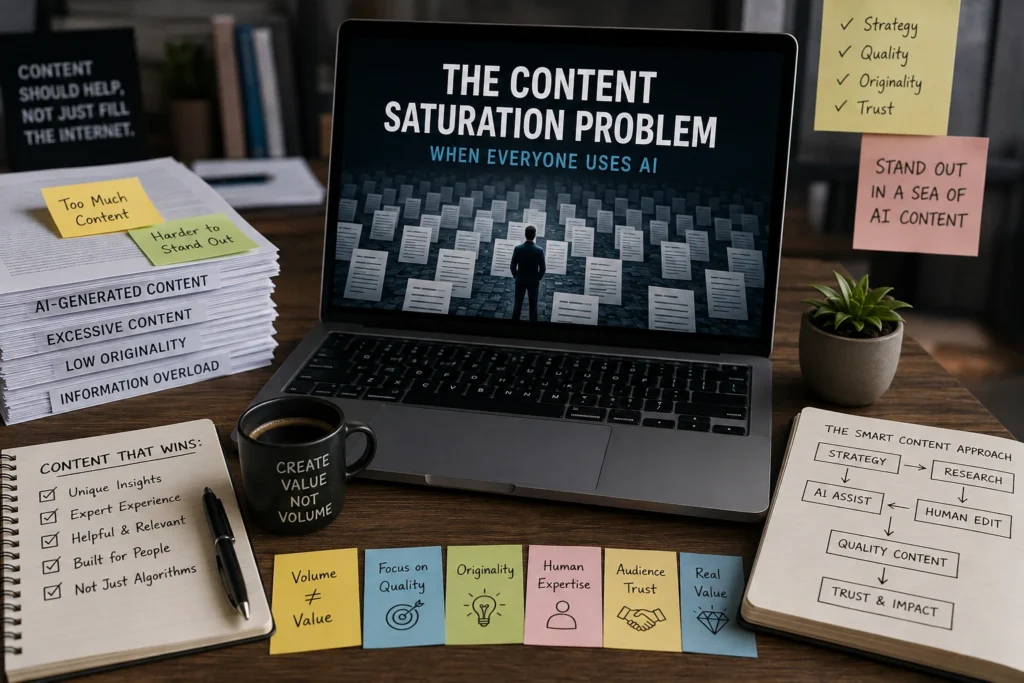
Artificial intelligence has transformed the way businesses, marketers, writers, and creators produce content. AI content saturation What once required hours of research, drafting, editing, and optimization can now happen within minutes. AI writing tools have lowered the barrier to content creation, allowing almost anyone to publish articles, social media posts, product descriptions, emails, and marketing materials at an unprecedented scale. However, this convenience has created a new problem: AI content saturation. When everyone can produce more content, the internet does not necessarily become more valuable and Originality in the AI Age. Instead, it can become increasingly crowded with material that looks, sounds, and communicates in remarkably similar ways. Consequently, businesses now face a difficult question: if everyone uses AI to create content, how can anyone stand out? The answer does not involve abandoning artificial intelligence. Rather, organizations must learn to use AI differently. The competitive advantage will no longer come from simply publishing more content. Instead, it will come from producing content that demonstrates originality, expertise, relevance, human judgment, and genuine value. 1.The AI content saturation: Originality in the AI Age Before generative AI became widely accessible, producing a substantial volume of content required significant human resources. A company needed writers, editors, researchers, designers, and marketers to maintain a consistent publishing schedule. Although businesses could outsource some of this work, content production still involved considerable time and expense Originality in the AI Age. AI has fundamentally changed that equation. Today, a marketer can generate dozens of potential headlines, draft an article, summarize research, create social media posts, and develop email campaigns in a fraction of the previous time. Therefore, businesses have gained an enormous productivity advantage. Nevertheless, when millions of organizations gain access to the same capability, productivity alone stops providing a meaningful competitive advantage AI content saturation. 2.AI content saturation: The Internet Has a Volume Problem Content saturation occurs when audiences encounter more information than they can reasonably consume or evaluate. The problem becomes particularly serious when multiple pieces of content address the same subject using similar arguments, structures, examples, and language. AI-generated content can accelerate this process because many systems draw upon broadly available patterns and commonly expressed ideas. As a result, publishing another generic article about a familiar topic may produce very little impact. A company might create a perfectly structured 1,500-word article that contains all the expected SEO keywords, yet readers may find nothing memorable within it Originality in the AI Age. The content technically satisfies the requirements of publishing, but it fails to give the audience a compelling reason to choose it over hundreds of competing pages. 3. The Similarity Trap: Why AI Content Often Sounds the Same(Originality in the AI Age) One of the biggest challenges surrounding AI-generated content involves stylistic similarity. AI systems learn patterns from enormous quantities of existing text. When users provide conventional prompts, the resulting output often follows conventional structures: introduction, several predictable headings, generalized explanations, examples, and a conclusion. That structure is not inherently bad. In fact, clear organization improves readability. However, excessive dependence on predictable structures can make thousands of articles feel interchangeable. Phrases such as “in today’s digital landscape,” “businesses must adapt,” and “as technology continues to evolve “Originality in the AI Age may communicate legitimate ideas, but repeated use can make content sound generic and manufactured. Therefore, businesses should stop treating AI as an automatic replacement for human thinking. Instead, marketers should use AI to accelerate research, brainstorming, outlining, editing, and repetitive tasks while retaining human control over the central argument. The more distinctive the thinking behind the content, the less likely the final product will resemble everything else online. 4.SEO After the AI Boom: Keywords Are No Longer Enough For years, many businesses treated SEO primarily as a keyword-placement exercise. Marketers identified high-volume search terms, incorporated them into articles, built backlinks, and attempted to create enough pages to capture search traffic. While search optimization remains important, the explosion of AI content has made superficial optimization much less useful as a competitive strategy. When thousands of websites target the same keyword with broadly similar information, simply including the keyword does not make a page valuable. Search engines increasingly need to distinguish between content that genuinely satisfies a user’s information need and content that merely targets a query. Consequently, marketers should focus on search intent, firsthand experience, useful evidence, clear explanations, and unique perspectives rather than keyword repetition. This does not mean businesses should abandon keywords. Instead, they should use keywords as signals that help define the subject while building the actual content around the audience’s questions and problems. Strong SEO should make valuable information easier to discover, not turn an article into a collection of strategically placed phrases. 5.Originality in the AI Age Becomes the New Competitive Advantage When content production becomes cheap, originality becomes more valuable. This principle applies far beyond AI. Whenever technology reduces the cost of producing something, the market eventually becomes crowded with similar products. At that point, Originality in the AI Age distinctive qualities become more important because consumers have numerous alternatives. For content marketing, originality can take several forms. A company might conduct its own research, publish original survey results, interview customers, analyze proprietary data, document experiments, or present an unconventional interpretation of an industry trend. Similarly, an expert can draw from professional experience and explain situations that generic AI-generated articles cannot realistically reproduce. Therefore, businesses should ask a more demanding question before publishing: What does this content provide that another competent writer could not easily reproduce? If the answer is nothing, the content probably needs stronger differentiation. 6. Human Expertise: The Asset AI Cannot Automatically Manufacture AI can summarize information quickly, but it Originality in the AI Age does not automatically possess firsthand experience with a company’s customers, products, failures, decisions, or internal processes. Human expertise therefore remains one of the most valuable resources in an increasingly automated content environment. For example, a cybersecurity company can publish a generic article explaining common security threats. However, an experienced security

Marketing Automation Tools Worth Paying For
Uncategorized

Marketing Automation Tools Compared: What’s Actually Worth Paying For?

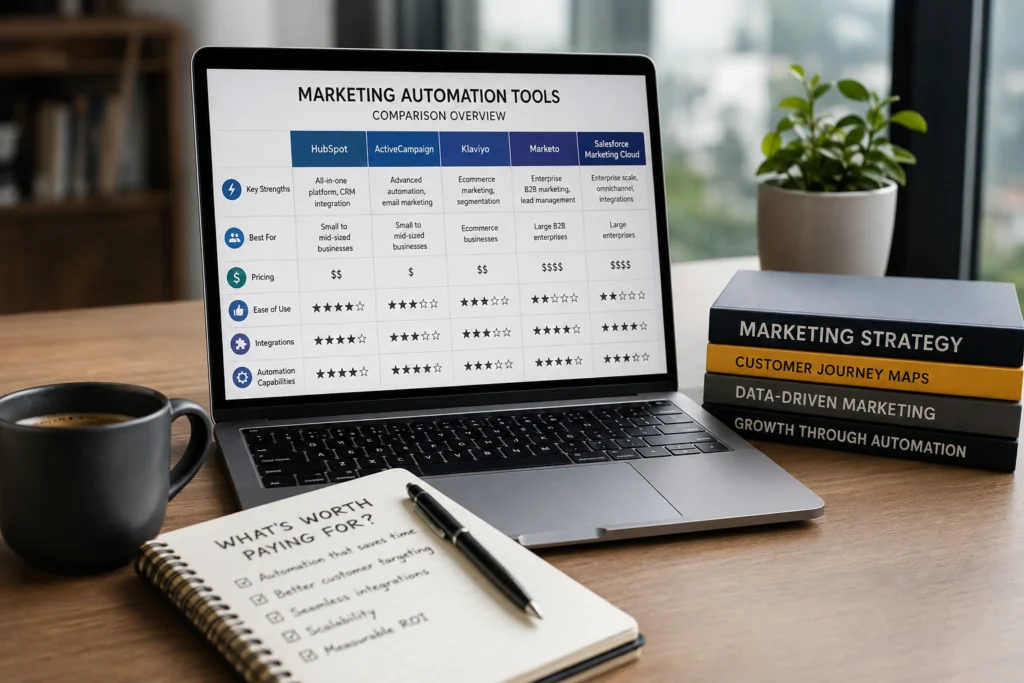
Marketing Automation Tools Worth Paying Forhas moved far beyond scheduling email newsletters. Today, businesses can automate lead nurturing, customer segmentation, abandoned-cart campaigns, sales notifications, personalized messaging, reporting, and entire customer journeys. However, greater functionality does not automatically mean greater value. That distinction matters because marketing automation software can become one of the more expensive items in a company’s technology stack. A platform may advertise artificial intelligence, advanced analytics, omnichannel campaigns, and sophisticated workflows, yet a small marketing team might use only a fraction of those capabilities. Therefore, businesses should evaluate automation tools according to actual operational needs rather than buying the platform with the longest feature list. The market now includes solutions such as HubSpot, Active Campaign, Marketing Automation Tools Worth Paying For ,Adobe Marketo Engage, Salesforce Marketing Cloud, Klaviyo, Drip, Brevo, Mailchimp, and other specialized platforms. Each serves a different type of organization, and each comes with different trade-offs involving price, complexity, integrations, scalability, and usability. 1.The Automation Gold Rush: Why Businesses Are Buying More Software Marketing Automation Tools Worth Paying For tools promise an obvious benefit: they reduce repetitive manual work. Instead of asking employees to send every follow-up email, update every lead record, or manually segment every customer, businesses can establish rules that trigger these activities automatically. Consequently, marketers can spend more time developing strategy, content, and campaigns. Nevertheless, automation does not solve poor marketing strategy Marketing Automation Tools Worth Paying For. If a business has weak messaging, inaccurate customer data, or an unclear sales process, automation can simply make those problems happen faster. A poorly designed workflow can send irrelevant messages to thousands of customers in minutes. Therefore, the real value of marketing automation comes from combining reliable data, thoughtful customer journeys, and measurable objectives. 2. HubSpot: Paying for Convenience and an All-in-One Ecosystem HubSpot Marketing Hub remains one of the strongest choices for businesses that want marketing automation closely connected with CRM, sales, content, landing pages, forms, and analytics. Its major advantage lies in consolidation. Rather than forcing a team to manage numerous disconnected systems, HubSpot can bring several marketing and customer-management activities into one ecosystem. However, convenience has a price. The gap between entry-level functionality and advanced automation can become significant as a company grows. Current comparisons place HubSpot’s more serious automation capabilities around its Professional tier, while Enterprise functionality costs considerably more. Contact-based pricing can also increase expenses as the database expands. Marketing Automation Tools Worth Paying For Businesses should consider HubSpot when CRM integration, reporting, content management, and marketing automation genuinely need to operate together. Conversely, a company that only needs newsletters and a few automated sequences probably does not need the full platform. 3.ActiveCampaign: Marketing Automation Tools Worth Paying For Marketing Automation Tools Worth Paying For Active Campaign takes a different approach. Instead of positioning itself primarily as an enormous enterprise ecosystem, it focuses heavily on customer journeys, email automation, segmentation, lead management, and CRM-related workflows. That focus makes it particularly attractive to small and mid-sized businesses that want sophisticated automation without immediately adopting an enterprise marketing stack. The platform demonstrates an important principle in software purchasing Marketing Automation Tools Worth Paying For: specialized functionality can provide better value than excessive breadth. ActiveCampaign can support multi-step automation and behavioral triggers at a considerably lower entry point than many enterprise alternatives. Its current published comparison also lists entry-level pricing from $15 per month for 1,000 contacts, although actual costs depend on the plan and database size. Marketing Automation Tools Worth Paying ForIf automated nurturing, segmentation, sales follow-up, and lifecycle communication represent the core requirements, ActiveCampaign can provide a strong return on investment. Businesses should not pay for an enormous enterprise ecosystem simply because it offers more features. 4.Klaviyo and Drip: Where Ecommerce Automation Earns Its Keep Ecommerce businesses have different automation requirements from traditional B2B companies. Purchase history, product browsing, abandoned carts, customer lifetime value, repeat purchases, and promotional behavior all influence marketing decisions. Therefore, ecommerce brands should prioritize platforms that understand commerce data rather than simply adding an online-store integration to a generic email platform. Klaviyo and Drip are strong examples. Klaviyo emphasizes ecommerce data, segmentation, email, SMS, and behavioral customer profiles, while Drip focuses specifically on ecommerce and direct-to-consumer revenue automation. Current comparisons identify Klaviyo as a strong choice for data-heavy ecommerce and Drip as a platform built around ecommerce revenue workflows. Marketing Automation Tools Worth Paying For Ecommerce companies should pay for accurate behavioral tracking, revenue attribution, purchase-based segmentation, abandoned-cart automation, product recommendations, and lifecycle campaigns. Those capabilities can directly influence revenue. Paying for advanced B2B lead-scoring features, however, may deliver little value to a retailer. 5. Marketo: Enterprise Power Without Enterprise Simplicity Adobe Marketo Engage targets organizations with sophisticated B2B marketing operations. It becomes particularly valuable when businesses need complex lead nurturing, advanced scoring, account-based marketing, multiple brands, and deep integrations with enterprise systems. In such environments, Marketo’s complexity can become an advantage rather than a weakness. Yet smaller organizations should approach it carefully. Marketo typically involves quote-based enterprise pricing, and the cost extends beyond the license. Implementation, integration, administration, training, and ongoing optimization can require substantial internal or external resources. As a result, buying Marketo before the organization has sufficient operational complexity can create unnecessary expense. What is worth paying for? Large B2B organizations with dedicated marketing operations teams can justify Marketo when sophisticated demand generation and account-based marketing directly support substantial revenue. Smaller companies should generally consider simpler platforms first. 6.Salesforce Marketing Cloud: Powerful, but Not Automatically Cost-Effective Salesforce Marketing Cloud occupies the enterprise end of the market and makes particular sense for organizations already deeply invested in Salesforce. Its strength comes from connecting customer data and marketing journeys across channels, including email, mobile messaging, advertising, and other customer touchpoints. However, businesses should distinguish between technical capability and economic value. Enterprise platforms can require implementation partners, specialized employees, additional modules, and extensive configuration. Therefore, the software license represents only one part of the total cost of ownership. Current market comparisons also highlight implementation and staffing

Scroll to Top